
Last Updated on January 23, 2026 by NursingLearn Team
Table Of Content
- What Is the Glasgow Coma Scale?
- Breaking Down the Components: E, V, M
- Eye Opening (E)
- Verbal Response (V)
- Motor Response (M)
- Interpreting the Score: More Than Just a Number
- The Nurse’s Role in GCS Monitoring
- How Often Should GCS Be Checked?
- Common Errors and How to Avoid Them
- Special Considerations
- GCS in the Context of Holistic Neurological Assessment
- Communication and Documentation: Turning Observations into Action
- REFERENCES
Glasgow Coma Scale (GCS) monitoring is one of the most important bedside skills in nursing, especially in emergency, critical care, neurosurgical, and even general ward settings. A few numbers on a chart can be the first warning that a patient is deteriorating, yet those numbers only have meaning if they are assessed and documented correctly. This post walks through GCS from a nursing perspective: what it is, how to assess it accurately, and how to use it to protect your patients from avoidable harm.
What Is the Glasgow Coma Scale?
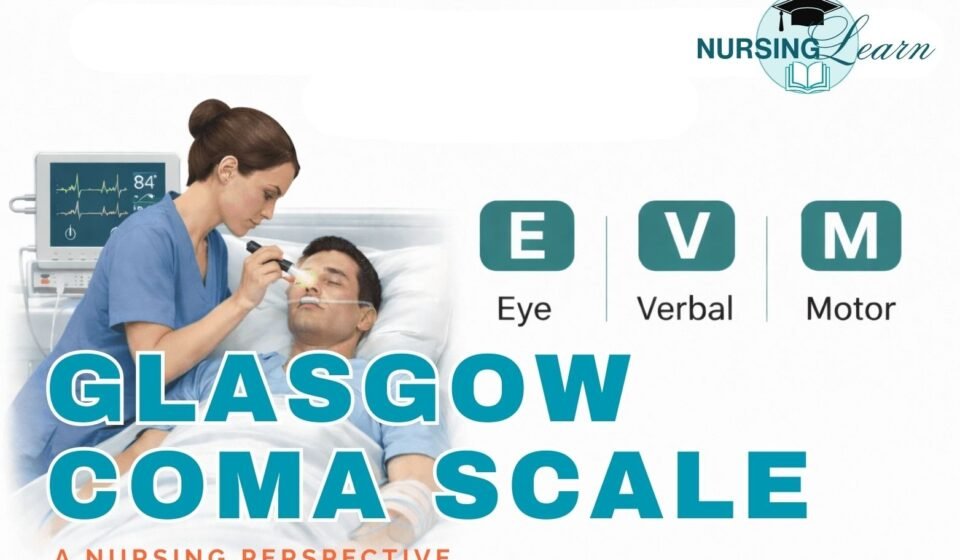
The Glasgow Coma Scale is a standardized tool used to assess a patient’s level of consciousness based on three simple but powerful observations: eye opening, verbal response, and motor response. Each component is scored separately, then combined into a total score ranging from 3 (deep coma or death) to 15 (fully awake and oriented).
For nurses, GCS offers a common language. Instead of saying “the patient looks a bit drowsy,” you can report “GCS 13, E3 V4 M6, drop of 2 points in the last 30 minutes.” That clarity supports faster decision-making, safer handovers, and earlier escalation when something is going wrong.
Breaking Down the Components: E, V, M
Eye Opening (E)
Eye opening is usually the easiest part of the GCS, but it is often rushed. You are assessing how spontaneously and appropriately the patient opens their eyes:
- E4 – Eyes open spontaneously
- E3 – Eyes open to speech
- E2 – Eyes open to pain
- E1 – No eye opening
From a nursing perspective, the key is consistency. Always start with voice: call the patient by name before jumping to painful stimuli. If there is significant facial trauma or swelling, the eyes may not be testable. In such cases, document clearly (for example, “eyes closed due to swelling”) rather than scoring incorrectly, and follow your facility’s convention for “not testable.”
Verbal Response (V)
Verbal response reflects more than just whether a patient can talk; it gives information about orientation, cognition, and possible neurological decline:
- V5 – Oriented and appropriate
- V4 – Confused conversation
- V3 – Inappropriate words
- V2 – Incomprehensible sounds
- V1 – No verbal response
This is where context matters. A patient may be intubated, have a tracheostomy, be deaf, or speak a different language. Nurses must interpret verbal response through the lens of that context and chart accurately (for example, following local practice such as “V-NT” for not testable, or annotating “intubated”). Always consider baseline: a patient with dementia may never be truly “oriented,” yet changes from their usual mental status are still clinically significant.
Motor Response (M)
Motor response is often the most sensitive part of the GCS and can reveal early deterioration even when eye and verbal scores change only subtly:
- M6 – Obeys commands
- M5 – Localizes pain
- M4 – Withdraws from pain
- M3 – Abnormal flexion (decorticate)
- M2 – Extension to pain (decerebrate)
- M1 – No response
For nurses, the difference between “localizes pain” and “withdraws from pain” is crucial. Localizing means the patient purposefully moves a limb towards the painful stimulus, trying to remove it. z
Withdrawing is more of a generalized pulling away without clear purpose. It is also good practice to use central pain (e.g., trapezius squeeze, supraorbital pressure) rather than relying only on peripheral stimuli like nail bed pressure, which may be affected by local injuries or peripheral neuropathy.
Interpreting the Score: More Than Just a Number
Once you have E, V, and M, you add them to get the total GCS. However, the total score should never be interpreted in isolation. Two key principles help guide nursing practice:
- Component scores matter. A patient with E4 V1 M6 (GCS 11) is very different from a patient with E2 V4 M5 (also GCS 11). The first may be intubated but obeys commands; the second is spontaneous but has poorer motor function and speech.
- Trends are critical. A drop of 2 or more points from the patient’s baseline, or a deterioration in any single component (especially motor), should be treated as a red flag and escalated promptly.
- Many services roughly interpret GCS as:
- 13–15: Mild impairment
- 9–12: Moderate impairment
- 8 or below: Severe impairment / coma and potential need for airway protection
- As a nurse, your job is not to “diagnose” based on the number, but to recognize when the number and its components signal danger and to act quickly.
The Nurse’s Role in GCS Monitoring
GCS monitoring is not a once-off checklist; it is an ongoing responsibility embedded in routine care. Key nursing responsibilities include:
- Performing consistent, accurate neurological observations using the same approach each time
- Recognizing early deterioration, even subtle changes like confusion, slower responses, or new asymmetry
- Escalating changes promptly using a structured communication tool such as SBAR
- Documenting clearly, including the time, stimulus used, and exact E/V/M scores, not only the sum
Nurses are often the first to notice that “something is not right.” An accurately scored and documented GCS allows that concern to be translated into objective, actionable information for the wider team.
How Often Should GCS Be Checked?
The frequency of GCS observations depends on the patient’s condition, diagnosis, and local policy. In higher-risk patients—such as those with head injuries, post-neurosurgery cases, or sudden collapses—neurological observations are usually carried out very frequently initially, then spaced out if the patient remains stable.
Common patterns include very frequent monitoring (for example, every 15–30 minutes) early on, then moving to hourly and later two-hourly checks as the risk decreases and stability is demonstrated. Regardless of the exact schedule, nurses should always think clinically: if a patient’s condition changes, do not wait for the “next scheduled obs.” Assess now and escalate as needed.
Common Errors and How to Avoid Them
Even experienced nurses can fall into patterns that reduce the reliability of GCS scoring. Some common errors include:
- Copying previous observations instead of reassessing carefully each time
- Using different stimuli or techniques from one nurse to another, leading to inconsistent scores
- Focusing only on the total GCS and ignoring shifts in individual components
- Failing to note why a component cannot be assessed, such as intubation or severe facial swelling
Avoiding these pitfalls requires a combination of knowledge, vigilance, and a culture in which it is acceptable to slow down and reassess rather than simply “tick boxes.” Regular refresher training, bedside coaching, and peer feedback can all improve practice.
Special Considerations
Real patients rarely fit textbook examples. Several common situations complicate GCS assessment and demand careful nursing judgment:
- Intubated or tracheostomized patients: Verbal response cannot be assessed in the usual way. Use your unit’s standard notation and consider adjunct measures such as sedation scores.
- Sedation and neuromuscular blockade: Sedatives and paralytics can artificially depress GCS, so always link the score to timing and dosing of these medications.
- Severe facial trauma or swelling: Eye opening may be mechanically impossible. Clearly document why eyes cannot open rather than scoring E1 as if it were neurological.
- Pre-existing cognitive impairment or aphasia: Understand and document the patient’s baseline. Deterioration from their norm is still clinically important, even if they never reach a “perfect” GCS.
- In all these scenarios, collaboration with the multidisciplinary team is essential, and nurses play a central role in sharing nuanced observations that go beyond raw numbers.
GCS in the Context of Holistic Neurological Assessment
GCS is only one part of a comprehensive neurological assessment. To truly protect your patient, combine GCS with:
• Pupil size, symmetry, and reaction to light
• Limb strength, tone, and symmetry
• Vital signs, especially blood pressure, heart rate, respiratory rate, and oxygen saturation
• Signs of raised intracranial pressure, such as vomiting, headache, or new onset bradycardia and hypertension
• Level of agitation, pain, and sedation scores
Together, these data points create a fuller picture of brain function and help the team decide whether imaging, transfer to a higher level of care, or urgent intervention is required.
Communication and Documentation: Turning Observations into Action
Accurate assessment is only useful if it leads to timely and appropriate action. Good documentation and communication are the bridge between bedside observations and medical decision-making. Consider the difference between:
• “Patient more drowsy, please review”
• “At 12:00, GCS decreased from E4 V5 M6 (15/15) to E2 V4 M5 (11/15) over 30 minutes. New headache and unequal pupils. Please review urgently.”
The second statement is clear, objective, and compelling. Using SBAR (Situation, Background, Assessment, Recommendation) helps you structure that information so that nothing critical is missed.
REFERENCES
- Glasgow Coma Scale (GCS): Understanding & Interpretation, Nurseslab,
August 5, 2024 https://nurseslab.in/procedures/glasgow-coma-scale/ - Glasgow Coma Scale (GCS), Cleveland Clinic, Last updated on 03/26/2023. https://my.clevelandclinic.org/health/diagnostics/24848-glasgow-coma-scale-gcs